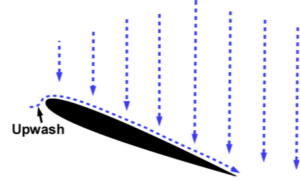
So, what are the implications of this? It means that, except for a small, low-velocity flow drawn in by the lower pressure, there is no flow over the wing to which one can apply the Bernoulli equation.
A wing moves through the air. It is not the air moving over the wing (which is what occurs in a wind tunnel). Swing your flattened hand through the air. It is your hand moving, not the air. The situation is similar to riding a bike. You feel a breeze on your face when moving. Stop, and the breeze stops. You know it is your vehicle moving through the air and not the air moving over the vehicle when you drive.
If one were standing on a high hill watching an airplane fly by and had the power to see the air motion, Figure 1 is what they’d see. A wing draws down a great deal of air by the descending upper surface of the wing, producing the lift. A minimal amount of air is drawn over the wing’s surface by lowering the pressure. This small quantity of air does not produce lift because its lower pressure is just a reflection of the reduced pressure that drew it in.
But what about in a wind tunnel where the air does flow over the wing? The wind tunnel view is exactly what one would see if one were standing on the wing rather than on the hill or in a balloon. Likewise, if one were moving with the air in the wind tunnel, say on a feather with a camera. Figure 1 is exactly what one would see. The physics is the same. The physics of the lift on the wing cannot depend on the observer. What has changed is the Frame of Reference.